Class 8 Truck Orders
FTR tracks class 8 truck orders for the transportation industry and reports on preliminary order numbers on a monthly basis.
Don't miss the next Class 8 truck orders. Sign up to receive monthly updates.
FTR Reports Preliminary North American Class 8 Net Orders for September at 21,300 Units
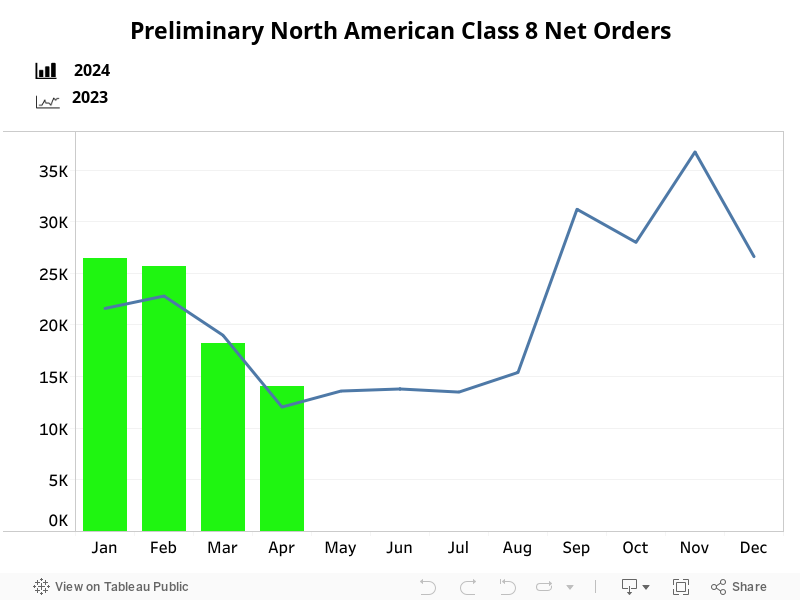
FTR reports that North American (N.A.) Class 8 preliminary net orders increased 18% month-over-month (m/m) and 3% year-over-year (y/y) to 21,300 units in September. Year-to-date orders through September totaled 263,499 units, up 95% y/y. Although the September m/m increase was smaller than typically seen seasonally, underlying demand remained fairly solid, supported by replacement needs, tight capacity, and firmer freight rates. Class 8 orders have totaled 351,244 units over the past 12 months.
Notably, September represented the transition to model year (MY) 2027 ordering. The EPA 2027 NOx pre-buy has ended, and surcharge-free MY 2026 engine build slots are effectively sold out. Some OEMs may have closed their MY 2026 order boards by early-to-mid August before opening MY 2027 books, potentially shifting some deferred orders into September.
The month also marked the first full period in which order activity reflected OEMs’ evolving pathways toward 2027 NOx compliance. Differences in those strategies – including whether OEMs plan to use nonconformance penalties (NCPs) – may also have influenced order activity.
Another source of uncertainty is pricing. MY 2027 order boards are opening before the EPA’s 2027 NOx regulation is finalized, so pricing could still change once the final rule is issued. Until there is greater regulatory and cost clarity, orders over the next month or two could remain near year-ago levels – a period when tariff and EPA 2027 NOx uncertainty weighed on demand.


©2026 FTR Transportation Intelligence. All rights reserved.